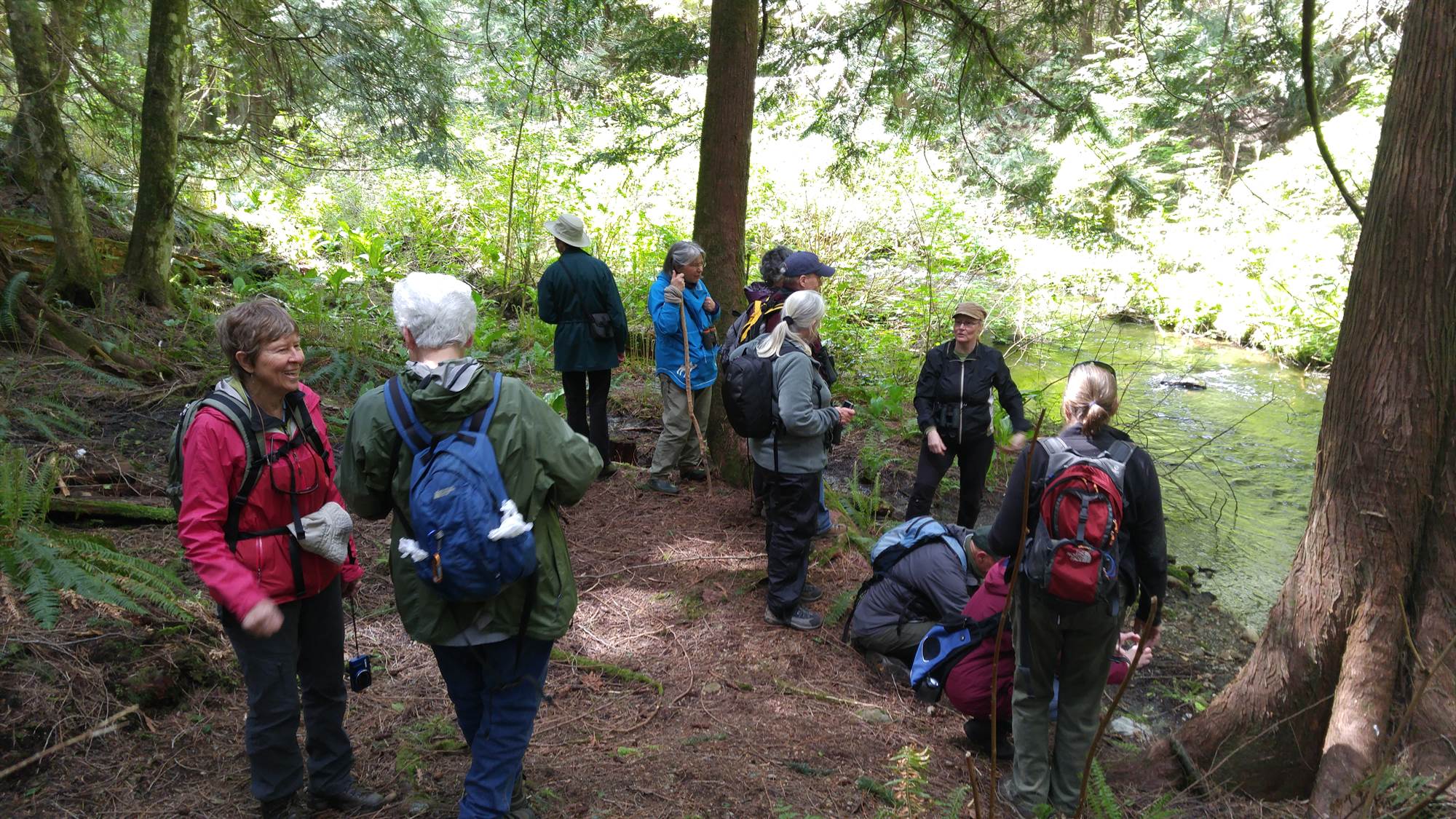







Cool, clean, year-round stream flows from springs in the headwaters make this little stream called Morrison Creek an excellent home to coho, pink, and chum salmon, as well as cutthroat and rainbow trout. The quality of the water and the dependability of the flow reduce Morrison Creek’s need for salmon enhancement. Furthermore, Morrison Creek is the only place in the world where the unique Morrison Creek Lamprey can be found.
Introducing the Morrison Creek Streamkeepers
The Morrison Creek Streamkeepers is a volunteer organization that has been working to maintain the health of this important little creek for over ten years. The streamkeepers carry out activities of all kinds, all dedicated to maintaining this stream as close to its original state as possible, in order to increase the number of salmon it produces and to maintain the genetic stocks of all the aquatic species that use Morrison Creek. Some of that salmon enhancement work is direct and some of it indirect but it all goes toward maintaining the overall health of the ecosystem which benefits all species, ours included.
While the Streamkeepers may not be the largest group doing salmon enhancement on Vancouver Island, they are one of the most dedicated and enthusiastic. This blog is a record in words, pictures and video of their numerous projects to improve and monitor the health of Morrison Creek. The Morrison Creek Streamkeepers work closely with the Comox Valley Conservation Strategy and sometimes undertakes joint projects with them.
Word reached Morrison Creek headquarters on Friday that the evil warlord Castor (nicknamed Bucky the Beaver) had taken hostile action in Nelly Creek. This encroachement took the form of totally damming a main culvert, choking it off completely and thereby blocking the legitimate aspirations of the Pink Salmon people for a spawning ground of their own. Something needed to be done immediately. Beaver dam removal was needed.
An initial scouting mission on Friday afternoon confirmed that things were every bit as bad as had been reported. Headquarters decided to send three members of the elite Salmon Team Six to deal with the situation.
A beaver dam removal team is dispatched
The commandos gathered at the Broken Spoke Cafe on Saturday morning. The team consisted of Jim Palmer, Bob Foster and Steve Harvey. After consumption of the requisite cafeinated beverages, and a quick stop at Current Environmental for extra armamaments, the team headed for Nelly Creek.
When the team arrived at the objective, it was obvious that a head-on assault wasn’t in the cards. The water behind the dam was much too deep to work in. Divers and explosives were briefly considered, but the absence of diving gear made that impossible. The only alternative was a sneak attack up the Culvert from downstream.
The plan was a simple one, as all good plans are. A steel cable would be attached to a six-foot crowbar. One of the team would sneak up to the dam through the culvert and ram the crowbar and cable through the dam. Other team members would attach a smaller crowbar to the cable. Then a pair of come-alongs would be hooked to the cable downstream of the dam. The idea was to pull the whole dam down the culvert and let it disintegrate downstream.
Specialist Palmer volunteered to go up the culvert with the cable, since he was the smallest man on the team.
The plan proceeded without a hitch, that is until the cable became detached from the small crowbar. A foothold had been gained, but it wasn’t nearly enough. A second attack was obviously going to be necessary.
A piece of good fortune appeared while the team was rerigging the cable. Specialist Palmer discovered an old anchor in the water. This was attached to the end of the cable and afforded a much better bite. Things were looking good.
And they were good. Partway through the second pull the cable suddenly went slack and a huge torrent of water began to drain from the pond above. All that was needed now was to let the water do its work, although some assistance was needed to remove all vestiges of the dam.
So Salmon Team Six was victorious. The way was opened for the salmon waiting downstream and the team left happy, having executed another successful beaver dam removal.
Of course, Buck Beaver won’t take this lying down. One beaver dam removal won’t be enough to stop him. He’ll be back soon with counter-measures of his own, but by then the fish will have spawned. This was just one small battle in the struggle to afford all species access to the resources they need to thrive. In fact, as the team departed, they seemed to hear Arnie Beaver promising I’ll be back!
Note: this account of beaver dam removal is obviously tongue-in-cheek. The language is outrageous, but the description of events is accurate.
The beavers will certainly be back. There’s time while the culvert is open to try some anti-beaver protection techniques. There’s a wealth of information about what works and what doesn’t in this PDF about beaver dam removal called Working With Beavers.
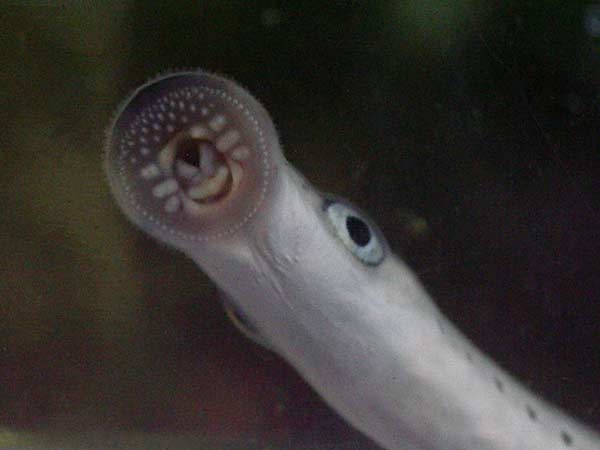
One of the little and elusive Morrison Creek Lamprey. For us old folks 17 cm equals about 7 in. Photo by K Inman
Dr Dick Beamish and his team were studying the Morrison Creek Lamprey, otherwise known as Lampetra richarsoni var. marifuga (just marifuga to its friends), in Morrison Creek again as there is almost more unknown than known about this unique little fish. He found considerably fewer lamprey in the creek than 25 years ago but more analysis will need to be done to determine whether this is because the collection locations, conditions and methods were different or whether there really are fewer lamprey around. He discovered that most of the marifuga seemed to be in the vicinity of Arden Road and appeared to be moving around in the creek. However, due to their small size these lamprey have difficulty handling higher velocities or small vertical drops that would not bother the salmon or trout that share the creek. We need to be very careful about any changes we make to the creek as we still don’t know where these little guys spend the time during their year as adults.
I have been trying to get a good picture of these pesky little falcons for months now and finally succeeded. Several months ago I saw one or two, sometimes three sitting at the very top of one of the large fir trees in the neighbourhood and tried to photograph them at maximum zoom freehand, which didn’t work too well as the shots were very blurry, then braced on a handy tree or post, which worked better but were still not great shots because of the distance (mature fir trees are taaall). They seemed then to be very noisy birds and then they went silent for quite a while and I wondered if they might have moved out of the area. Recently, they have been noisier than ever and the one or two has increased to five so I guess they were busy nesting and now they are teaching their three ‘kids’ to fly. Then they will probably move on to how to catch birds and other flying food. I saw one this morning glide off the wire, do a quick dip in flight and then the dragonfly that was in the vicinity was no longer there. Talk about effortless and efficient! According to the Birds of BC book that I consulted, they are considered rare breeding residents in most areas but if you look carefully (listening works better in my area) they can be found in several places in the Comox Valley.
Builders hard at work creating nest boxes. Photo by Ian Moul
Since the vegetation damaged by the salmon enhancement work we did two years ago has still not completely recovered we decided that our activities this year would be easier on the instream residents of Morrison Creek. As mentioned in a previous post, we did some invasive removal and replanting at 1st and Willemar as one project. Our second project was this nest box workshop where a couple dozen wonderful people created almost as many nest boxes for wood ducks or western screech owls, flickers, swallows, and chickadees. Our thanks go out to Ian Moul for leading this workshop as well as to Chuck Webster for creating the examples and templates that were displayed at Earth Day and to Shamrock fencing for donating much of the wood to create the boxes.
Video conversation between Jim Palmer and Hans Peter Meyer about the health of Morrison Creek. Good information about the impact of development on salmon enhancement concerns in the Comox Valley. The points raised about the importance of the creek’s being able to expand during high water times to reduce stream velocity is particularly interesting.